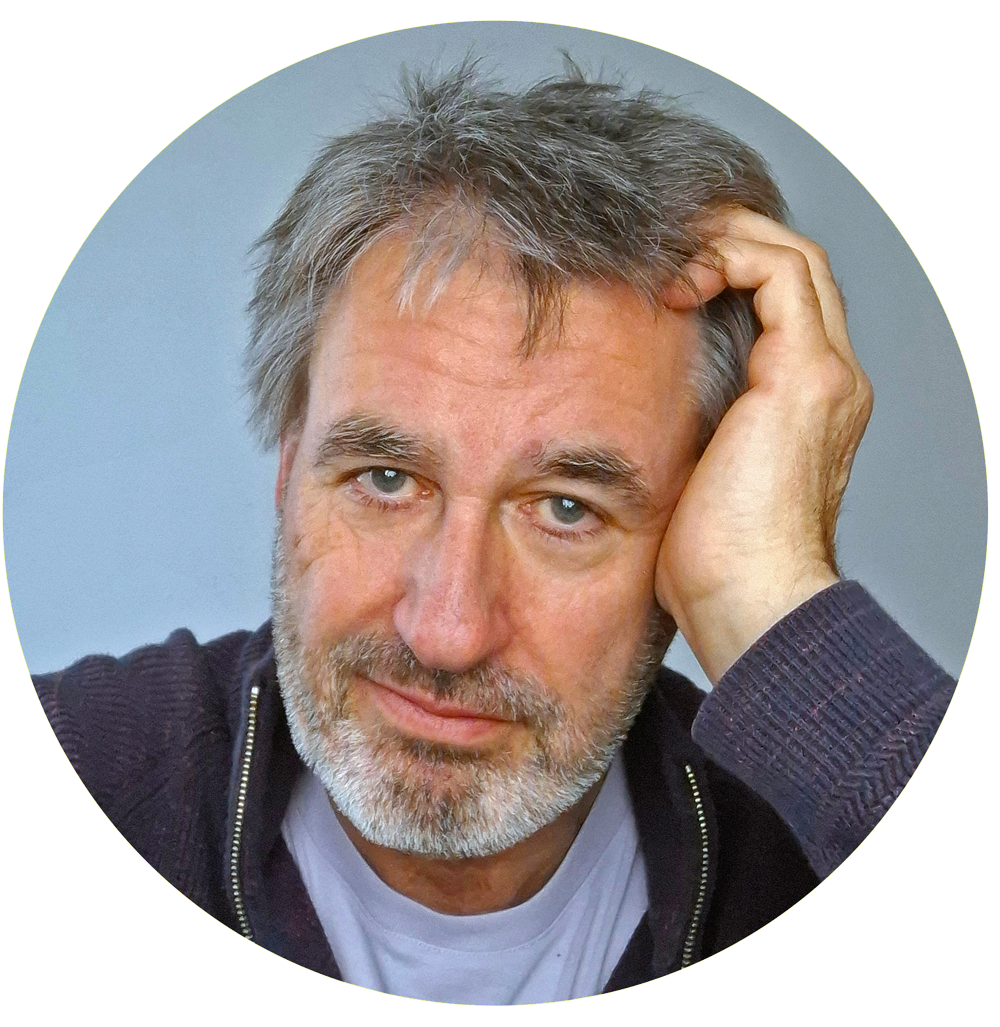
Professor Wolf
The train journey to Kolozsvár began in the morning mist. Mist was hardly unusual at that time of year, but it seemed unusually thick outside my window. On my way to the lavatory, I noticed that other seats were bathed in sunshine.
Well, well. Just two rows farther along, the broad, gently rolling, almost treeless landscape through which the train rattled merrily was much easier to admire. It looked homely out there, peaceful, almost like the Shire. You felt like lying down in the grass, softened by sheep droppings, and gazing up into the cloudless sky.
Kolozsvár, then. The city of three names. Cluj-Napoca in Romanian, and what was it again? Oh yes, Klausenburg in German. A tiny bell tinkled somewhere at the back of my mind. Where had I heard that name before?
By the time we pulled into the station, I remembered. That would be my opening line when I greeted the professor. A brilliant joke!
My accommodation was wonderfully central: all I had to do was walk a few kilometres south from the station along the dead-straight Strada Horea, a four-lane boulevard of consummate shabbiness, cross the Somesch, something resembling a river – and there I was.
The hotel was called, inevitably, ‘Transsilvanien’ – in German, mind you – and occupied an inner courtyard with a balcony running all the way round its first floor, giving access to the rooms. Mine was only slightly larger than the bath towel spread across the bed, whose outline could be made out through the threads of the towel. Still, the window was cleaner than the one on the train, even if the door didn’t shut properly.
So the camera would have to come with me on my reconnaissance walk, whereas the rest of my luggage, after six days on the road, seemed unlikely to tempt a thief.
It was only a short walk to Union Square, with its fourteenth-century Gothic St Michael’s Church and the equestrian statue of Matthias Corvinus, regarded as Hungary’s greatest king.
‘Matthias Rex’ proclaimed the large cast-metal letters on the plinth.
‘Manchester United’ proclaimed an enormous flag that all but hid the statue, for several thousand English football fans had gathered between the church and the king.
For on that Tuesday, the second matchday of the Champions League group stage, the internationally insignificant CFR Cluj was hosting the Red Army of world football.
Almost twelve hours before kick-off, the square, already cramped with giant screens, loudspeaker towers and drinks stalls, was swarming with English supporters. As usual, they were doing their utmost to weaken the opposition before the match: belting out legendary anthems at maximum volume while helping themselves to the enemy’s beer supplies. Transylvania’s second fast-food outlet, a KFC this time, made an excellent base camp.
Not that the fans were needed. Even without them, Kolozsvár surpassed everything I had so far encountered on my travels in sheer density of life and noise. Anything with wheels seemed to be squeezing through the old, narrow streets, hopelessly overburdening them, while countless pedestrians wove between the vehicles at every conceivable speed: businessmen rushing, housewives shopping with purpose, bewildered tourists standing in the way, joggers hurrying nervously, people pushing walking frames moving slowly, beggars crouching by the kerb and rocking back and forth. Every inch counted, on pavement and road alike, while electric buses, tethered to their overhead wires, inflexibly cemented the traffic jams in place.
Fortunately, my destination was so central that at least the cars could not follow me there. Where I was heading, the cobblestones were large enough for you to sprain an ankle in the gaps between them. Stone bollards protected the corners of the ancient houses, lest some delivery van dare to seek the bliss of being able to stop there. Some alleys had simply been closed off with chains.
At the end of one such alley, and therefore visible from a distance, stood the city’s best-known building: the fifteenth-century birthplace of King Matthias.
Diagonally opposite, in something like a town palace, was the university I was looking for (Kolozsvár has more than one). Another celebrated son of Klausenburg had been born here too: István Bocskai, who ruled Transylvania roughly a century and a half after Matthias.
So this was where Mr Farkas held court, the third most important Hungarian of them all – to me, at least.
A heavy wooden gate opened with a soft hum when I rang the bell. As I entered, a very elderly porter hauled himself out of his armchair, announced me by telephone and even emerged from behind the security glass to greet me with the utmost courtesy and shuffle ahead of me towards the nearby stairs.
As though approaching an audience with royalty, I climbed the gleaming marble steps, my pace already considerably slowed by awe. From niches in the brilliant white walls, dark busts of once-important people regarded me with meticulous attention and a hint of suspicion.
Or was it my own confidence that was deserting me?
A remarkably lively woman with a few files tucked under her arm hurried past me up the stairs, not without wishing me jó napot. On the top step I hesitated before a double door, painted white with grey inlays.
The woman, already almost out of sight down one of the corridors, glanced back and noticed my hesitation. Smiling, she returned, opened the door for me and gestured inside.
‘Do go in,’ she said, now in English. ‘Emőd is expecting you!’
Emőd?
Was that a name or a title?
The first thing I saw was the back of an enormous computer monitor, turned to portrait orientation. Behind it, partly concealed, sat a well-fed man in a casual shirt, looking at me curiously over the rims of his glasses.
‘Mr Farkas?’ I asked hesitantly in English.
‘The very one!’ came the reply, and a broad, warm grin appeared beneath his rather sparse, faintly reddish beard. He got up at once and came round from behind the desk. Now I could see that he was wearing jeans and sandals. He looked to be in his mid-forties, had bright, pale-blue eyes and a thicket on his head that even the most generous imagination could not call a hairstyle.
‘So this is what the famous Professor Abronsius of Klausenburg looks like!’ I launched into my carefully prepared joke. ‘Polanski’s intrepid vampire hunter!’
‘You mean Königsberg, I presume,’ Farkas replied without a moment’s hesitation. ‘Professor Abronsius from Tanz der Vampire studied in Königsberg, not here in Klausenburg. A pity, really; I’d love to have a colleague like that! And we’re much closer to Count Dracula than the Prussians, aren’t we? Have you been to Schäßburg?’
I gave a brief nod.
Oh, dear God!
Of course it was Königsberg – it was an allusion to Kant. How embarrassing!
He had spotted my mistake immediately and, with the utmost charm, prevented me from going completely off the rails. Schäßburg. Dracula’s birthplace, my grandfather’s home town. We were already on familiar ground.
‘Since English is the only language we can use with each other,’ Farkas went on, ‘I suggest we call each other by our first names. I’m Emőd. Sit down!’
He fetched a chair for me, settled into his own rather expensive-looking armchair and pointed at the enormous monitor.
‘When you work chiefly for the dean of a Hungarian university in Romania, most of your time is spent writing letters begging for favours. So I’ve adapted the screen’s orientation to suit. For what we want to do, though, I’d better turn it back to landscape, since we’ll be looking at family trees.’
‘Richard. Pleased to meet you,’ I offered, a little belatedly, and added:
‘Emőd is an unusual name. I’ve never heard it before.’
Was that rude?
‘It’s old, very old. I’ve read that it has Scythian and Sarmatian roots. Apparently there’s a mountain range of that name in north-western India. That, in turn, is supposedly named after the verb emelkedni, meaning “to rise”. We have a town called Emőd in Hungary, too. I’ve never been there, though, and I doubt there’s anything particularly elevated to see.’
I moved my chair closer to the screen. What Emőd showed me was considerably more exciting than the etymology of Hungarian first names. Before me was an enormous family tree, branching out hundreds upon hundreds of times, in MyHeritage, a genealogy program. At the top left I could read the total number of people it contained: 2,715.
‘I haven’t researched all of it myself,’ Emőd explained. ‘There are a few good friends and some more distant acquaintances who kindly let me use their data, helping my own tree to flourish. The earliest entry dates from the late seventeenth century. A Mátéffy, incidentally.’
‘That was my maternal grandmother’s maiden name.’
‘I know. The pastor told me. And that’s extraordinarily interesting. Want to know why?’
Emőd grinned again. I sensed that he, too, had prepared for our meeting, though not with a silly joke. He must have had something rather better up his sleeve.
‘Your great-grandfather Ferenc, the one you were looking for in Szentábrahám, married a woman born Lőrinczy. Her brother Béla was the headmaster in Székelyudvarhely, a highly respected man. He had a son, Géza, who – as it happens – was my grandfather.
‘Do you know what that means?’
‘No. Well, perhaps. Hang on.’
Emőd was no longer grinning. He was laughing now.
‘Welcome home, my dear cousin!’